


Context graph / MCP / agents
A revenue context graph that compounds across your team
Legend holds every call, email and closed deal your team has run, works out what actually moved them, and keeps working it out. Every deal your team closes makes the next one easier. For everyone.
Live with revenue teams today
Dana's email is bouncing at Cargolane. Who else do I have?
Ran 3 commands, used legend integration, read 2 files
Dana ran the whole evaluation. She’s the only person who’s been on all 11 calls.
Your only other name is Marcus in procurement, cc’d twice, never replied once.
Two reps here have been through this. Both got back in through someone who sat in the technical review, not through procurement. Yours is Sanjay Rao. He’s been on 4 calls and you’ve never emailed him.
What I’d do — go to Sanjay directly, reference the migration thread he asked about, don’t route it through Marcus.
Learned from 2 deals you didn't run.
Files
- cargolane-stakeholder-map.html
- cargolane-migration-thread…
Context
Connectors
legendSkills
- legend-account-brief
- legend-objection-readiness
- legend-prep-and-share
Legend, running as an MCP connector inside Claude.
from your team’s history01 / How the graph learns
Four things the graph does, and it never stops doing them.
It's built from your deals, not from best practice.
The graph is made of your own calls, emails and closed deals. Nothing in it came from another company or from a vendor's idea of how selling works. If your team sells differently, the graph says something different.
It searches all of it, not the last quarter.
Every asset, every framing, every sequence and every piece of timing your team has used, compared against what the deal did next. That includes the deals run by reps who have since left.
It only learns what a person approved.
Nothing becomes what works here on the system's own say so. A human signs off before anything enters the graph as settled, and before anything reaches a buyer.
It never stops relearning.
Your product ships, a competitor changes their pitch, a segment goes cold. What used to win stops winning. The graph remeasures and the answer changes on its own, with nobody rewriting a playbook.
02 / The loop
Every deal teaches it. It teaches every rep. That’s what compounds.
01
IT SEES WHAT'S STUCK
The buyer who stopped showing up, the question answered three times that keeps coming back, the quote nobody opened.
02
IT COMPARES WHAT'S BEEN TRIED
Every deal your team has run that looked like this one, and what separated the ones that closed from the ones that didn't.
03
IT SERVES WHAT ACTUALLY CLOSED
The version that worked, not the version that got published. Drafted, sourced, and held for a person's approval.
04
THE OUTCOME WRITES BACK
What happened after it went out goes into the graph. The next answer is built on this one.
Nothing else in your stack gets better because you used it. This does.
03 / The graph
3 things Legend knows that nothing else in your stack does.
Not a record of activity. A live picture of every deal, built from what happened rather than what someone typed.
01
What happened
The timeline, not the documents. Every call, email and thread turned into deal state that sticks. Who said what, when, whether it ever got resolved, who stopped replying.
“The board approval Raj mentioned in March has never been confirmed. 184 days open.”
02
What's working
Across the whole team, all the time. Which moves unstick a deal at this stage, which objections actually get beaten, which sequences go quiet.
“Your team has handled this one before. Twice it worked, twice it didn't. Here's what was different.”
03
What moved the deal
The bit nobody keeps. Which email, which deck, which follow up came right before the stage change, and what the rep changed before sending it.
“The version Priya rewrote gets sent more than the approved one, and it closes better. Nobody has ever reviewed it.”
04 / What changes
You close more of the pipeline you already paid for.
Four things change. Each one comes from something only the graph can do.
Deals stop dying of silence.
Because the graph holds deal state over time, it can see absence. The economic buyer who came to two calls and then stopped. The quote that was never opened. The commitment from March that nobody closed out.
So the deal gets flagged three weeks before the rep notices. No decision is the biggest loss category in B2B and the most recoverable one, because nobody beat you. You just stopped being on the agenda.
The losing play stops getting run.
Because every asset, answer and framing is tied to what the deal did next, the graph knows which version wins and which one loses.
So the framing that lost five times doesn't get served to the sixth rep. Right now nobody in your company knows it lost five times, because nothing joins framing to outcomes.
New reps close sooner.
Because how deals in each segment were actually won is queryable instead of tacit, a rep in week two can see the twelve deals like the one in front of them.
So time to first close drops. Your VP of Sales already tracks that number, so it can be proved in a pilot rather than argued about.
Dormant pipeline gets worked.
Because agents run on the graph continuously instead of when a rep remembers, every stalled and closed lost account gets touched with something specific to why it stalled.
So you reactivate pipeline you already paid to create. Most teams carry three to five times more stalled and closed lost than open pipeline, and nobody works it because there's no time.
None of this is more pipeline. It's more of the pipeline you've already got.
05 / For CROs and VPs of sales
Your CRM tells you what someone typed.
THE TRUTH PROBLEM
Activity is not truth.
A CRM is human input. Put an agent on it and you get the same thing faster: a call happened, a stage moved, a note got written. None of that tells you whether the deal is real. Legend reads the activity and works out what it means. What's actually open. What's actually stalled. What's actually working, across every rep, with the evidence attached.
THE COACHING PROBLEM
Your team should get better without you in the room.
Right now the learning stops with whoever was on the call. Legend takes what worked and puts it in front of the rep who needs it next, through agents that run on their own. Objection handling, meeting prep, the follow up, the deck. Month on month the team gets better and you didn't have to run a single coaching session to make it happen.
You get the objective read on the pipeline, and a team that improves on its own. Both come out of the same graph.
06 / For GTM engineers
The one initiative that moves close rates without re-platforming.
You've probably built a version of this by hand already, out of a warehouse job, a few enrichment steps and a prompt you keep tuning. Legend is one MCP server with the whole revenue history behind it, and the team's winning patterns on top. Point Claude at it, or wire it into whatever you're already running.
NO RE-PLATFORMING
Your CRM stays where it is. We read from it, we don't replace it.
NO RETOOLING
Gong, Outreach, Highspot, Clay. Everything keeps working. They just get better inputs.
NO TRAINING
Nothing changes on the surfaces your reps use. The work shows up in Slack.
NO MIGRATION
Connect the sources you want, in the order you want. Add more later.
Ship it in a week. Nobody has to change what they use.
07 / Integrations
300+ integrations. Nothing to rip out.
Legend reads from the stack you already pay for. Connect what you want, when you want. Every integration is read first, so nothing breaks on day one.
CRM
Calls and meetings
Email and calendar
Messaging
Docs and storage
Enablement and content
Outbound and data
Marketing
Product and usage
Support
Planning
Warehouse
Quotes and contracts
Customer success
Forecasting
Scheduling
Don't see yours? It's probably already there, or it's a week away.
08 / Agents
6 agents. One job: the deal keeps moving.
Each one works a different part of the deal, and every one of them has read everything your company knows.
Deal state agent
01 / 06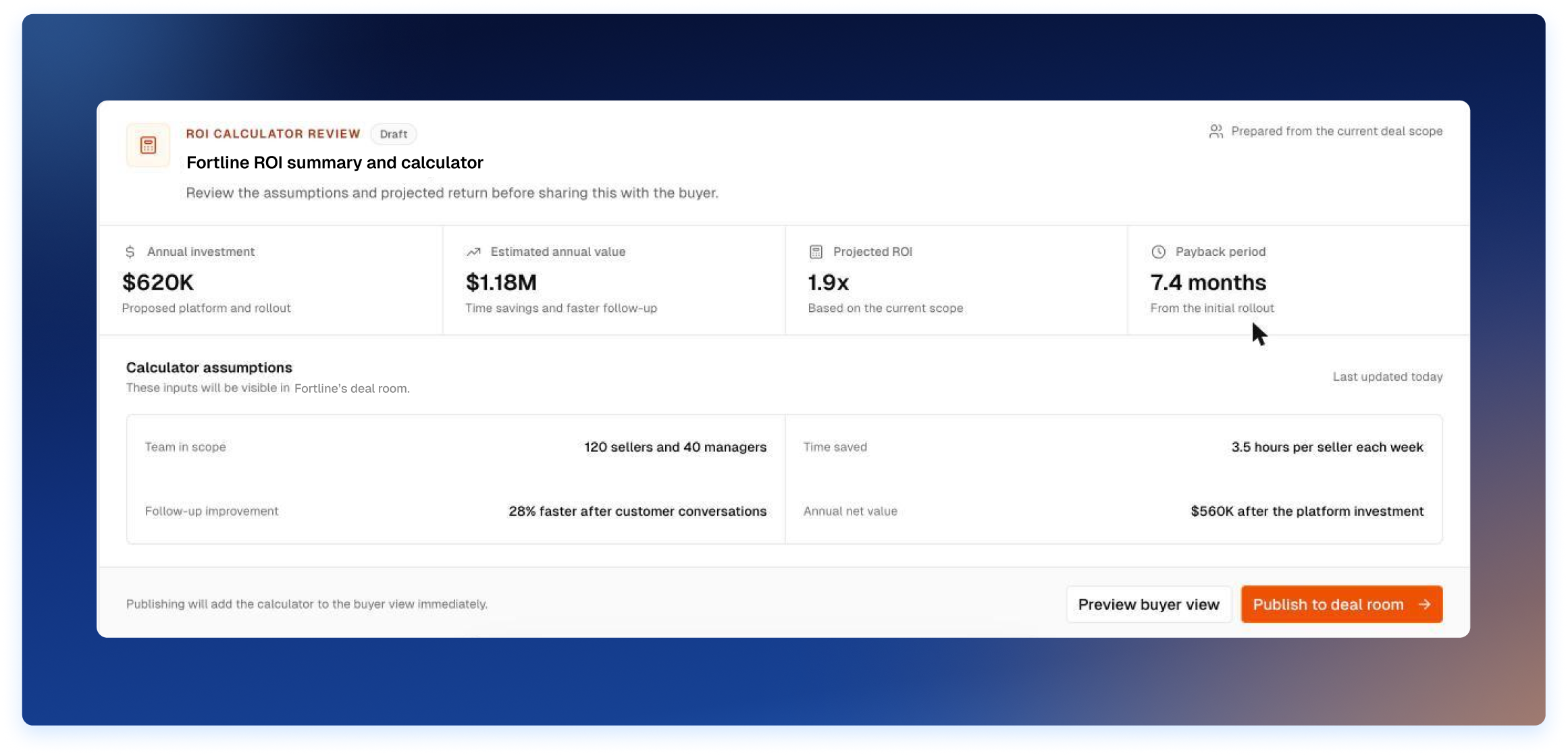
Watches every open deal for silence, stalled commitments and people who have quietly stopped showing up.
- Every agent drafts, a person approves. Nothing reaches a buyer without a rep's ok.
- Every output names its sources, so your team can trust it in seconds.
- Work shows up in Slack and Teams. No new tab to check.
Works where your reps already work
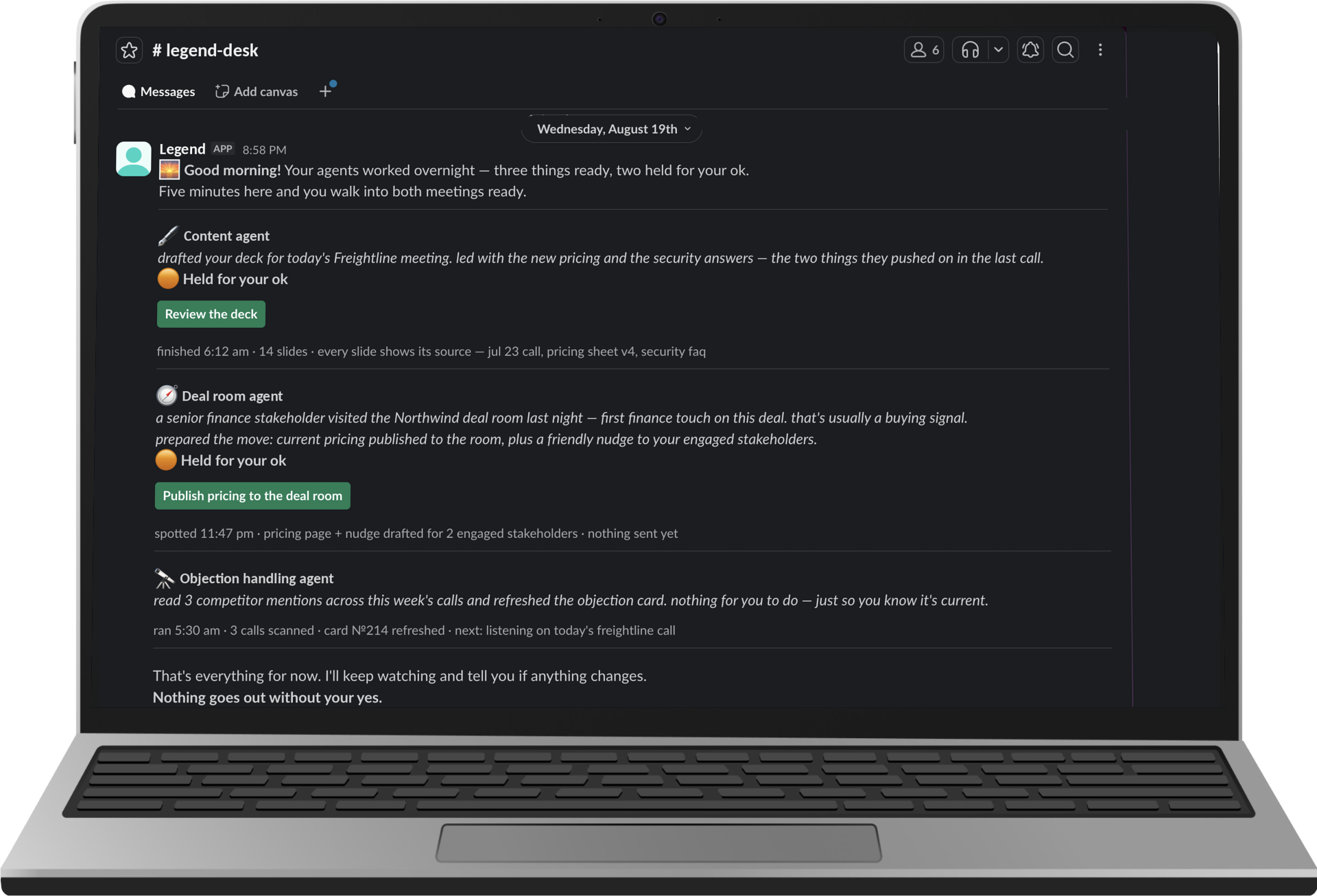
The work shows up in Slack, ready for your ok.
No new tab to check. Each morning the agents post what they finished overnight and what is held for your approval. You read it in the channel you already have open, and approve with one click.
- Finished work, not another notification to chase
- Approve, edit, or publish without leaving the channel
- Every item names its sources, so you can trust it fast
See what  already knows about deals like yours.
Legend is live and working in revenue teams today. Request a demo and we'll show you the graph on your own deals. Here's what you get, plainly:
Live in your stack in days, not quarters.
Legend connects to your CRM, calls and email, and starts learning from your history on day one. Most teams see their first insights inside a week.
We do the setup with you.
Complete onboarding, and day to day support from the people building the product, not a help widget.
Your feedback shapes the roadmap.
Feature requests go straight to the people building the product. You'll watch them ship.